

What is Industrial Hygiene?

Industrial Hygiene (IH)—also known as Occupational Hygiene—is the science and art of protecting worker health by managing the environment. While “safety” usually focuses on preventing sudden injuries (like a fall), “Industrial Hygiene” focuses on preventing illnesses that may take years to develop.
The Five Pillars of IH
The professional practice of Industrial Hygiene follows a specific lifecycle to manage risk:
- Anticipation: Researching a project before it starts to predict what hazards might be present based on materials and processes.
- Recognition: Walking the site to identify actual hazards (e.g., “I see a worker using a solvent without a vent”).
- Evaluation: Measuring the hazard. This is where IH gets technical—using air pumps, noise dosimeters, or radiation meters to get hard data.
- Control: Implementing the Hierarchy of Controls (Substitution, Engineering, etc.) to reduce the risk.
- Confirmation: Re-testing to make sure the controls actually worked.
Key Stressors (The Hazards)
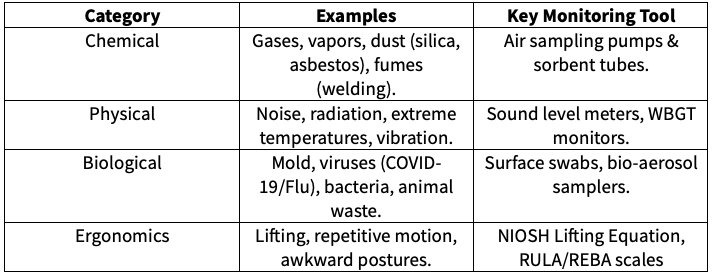
Industrial Hygienists categorize workplace “stressors” into four main groups:
Exposure Limits: How Much is Too Much?
IH relies on comparing measured data against legal and recommended limits. You will often see these acronyms:
- PEL (Permissible Exposure Limit): The legal limit set by OSHA. If you exceed this, you are breaking the law.
- TLV (Threshold Limit Value): The recommended limit set by the ACGIH. These are often stricter than OSHA and based on the most current health science.
- TWA (Time-Weighted Average): The average exposure over an 8-hour workday.
- STEL (Short-Term Exposure Limit): The maximum concentration allowed for a brief period (usually 15 minutes).
The Role of the Industrial Hygienist
Think of an Industrial Hygienist as a “Workplace Detective/Scientist.” Their responsibilities include:
- Investigating employee health complaints.
- Designing ventilation systems to pull toxins away from workers.
- Selecting the exact type of respirator or glove needed for a specific chemical (not all “rubber” gloves are the same).
- Training staff on how to interpret Safety Data Sheets (SDS).
Why it Matters (The Bottom Line)
Beyond just staying out of “OSHA Jail,” good industrial hygiene provides:
- Lower Insurance Costs: Fewer long-term disability claims for things like hearing loss or lung disease.
- Increased Productivity: Workers who aren’t fatigued by heat, noise, or poor ergonomics work faster and more accurately.
- Recruitment: Top-tier talent stays longer at companies that visibly care about their long-term health.
